Waste & Circular Economy: No More Trash – Use Everything Again

Think about a forest. Trees drop leaves, old logs decay, and everything eventually feeds something else. Nature has no waste. To build similar sustainable systems in the physical world, we must link our resource tracking with advanced management systems. Just as our AI Persistent Memory Guide tracks user contexts seamlessly across separate sessions, our industrial supply chains must track every material molecule to ensure it never turns into useless trash.
Why Linear Industrial Systems Fail Under Waste & Circular Economy Pressures
Every single year, traditional manufacturing loops throw away billions of tons of raw materials because they operate in a straight line: extract, make, dump. Transitioning into a robust waste & circular economy setup eliminates this bottleneck entirely, ensuring that every product is built to be broken down, upgraded, and recycled without any residual environmental damage.
Strategic Assessment Matrix: Waste & Circular Economy Performance
| Core Framework Metric | Linear Disposal Pipeline | Waste & Circular Economy Loop |
|---|---|---|
| Material Lifecycle Tracking | Finite line ending directly in landfills. | Infinite closed loop with zero raw loss. |
| Resource Reuse Rates | Extremely low (<9.4% standard retention). | Highly efficient (>82.8% cycle retention). |
Implementing a Clean Closed-Loop System Architecture
Shifting civilization into a zero-waste state requires methodical, humanized steps, matching the systematic logic of complex programming pipelines:
1. Designing Out Structural Waste
Products must be built without toxic combinations or deep adhesives. Every element should snap apart easily so that if a single component fails, it can be replaced easily without rendering the entire machine useless trash.
2. Segmenting Biological and Technical Streams
Materials split down distinct paths. Biological nutrients like organic waste return to nature safely as fertilizer, while technical nutrients like hardware polymers or precious copper wires flow continuously through manufacturing centers.
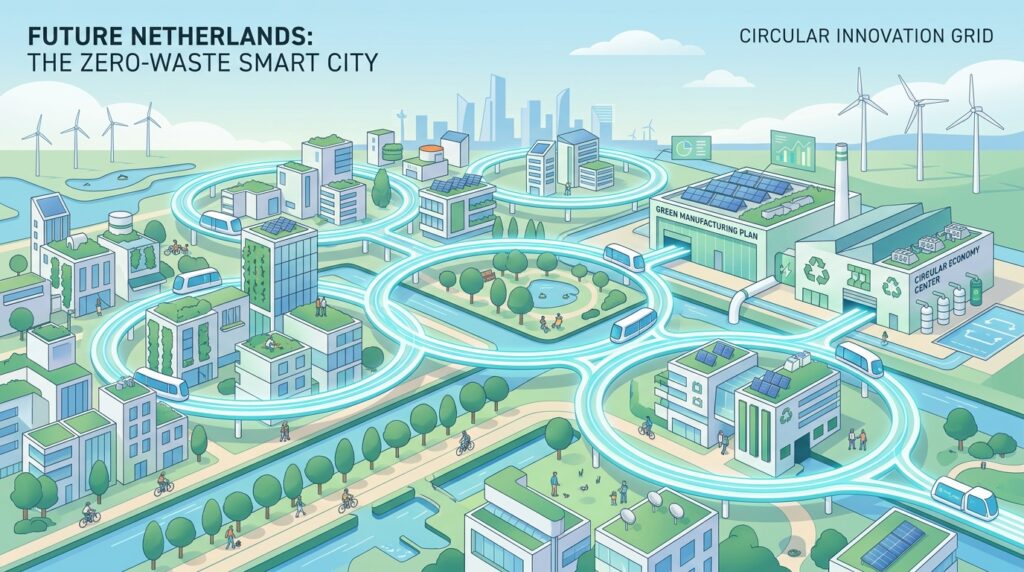
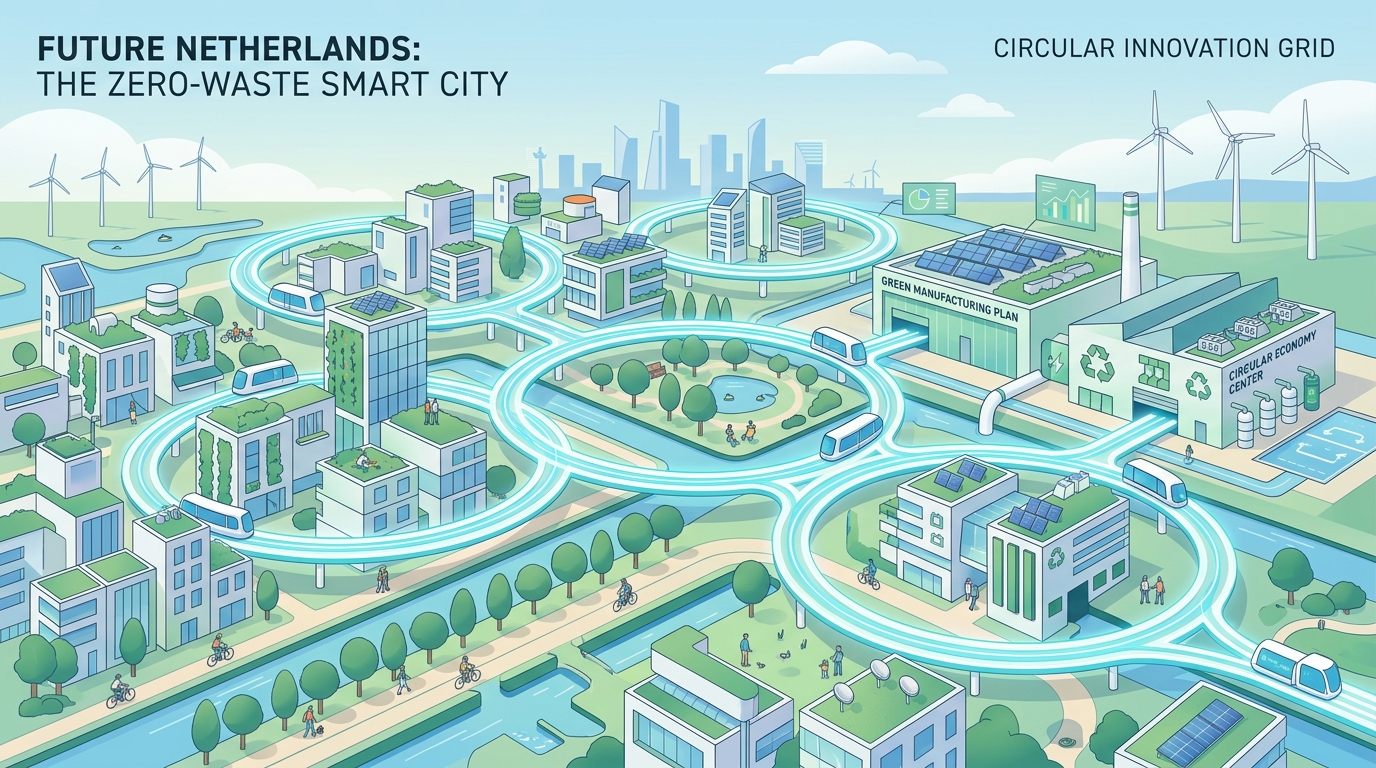
The Netherlands: A Living Model of Waste & Circular Economy Scaling
The Dutch government has deployed one of the world's most aggressive sustainability plans, legally targeting a 100% circular economy by 2050. You can verify their live regulatory frameworks directly on the official Government of the Netherlands Circular Platform.
Furthermore, continental initiatives are accelerating infrastructure funding for eco-labeling and repair networks. You can track these sweeping resource modifications live through the official European Union Circular Economy Community.
The Circular Economy Knowledge Base: 25 Direct Answers
Q1: Where does trash go when we throw it away?
A1: Traditionally, it sits inside massive underground landfills or gets burned in industrial incinerators. In a smart waste & circular economy setup, it returns to the factory as raw material.
Q2: Why is excess waste such a major global problem?
A2: Linear consumption patterns rapidly exhaust the planet's finite resources while polluting fragile oceanic and agricultural ecosystems with non-biodegradable synthetic trash.
Q3: What is a circular economy?
A3: It is an economic framework focused on completely eliminating industrial trash and system pollution by keeping tools, materials, and components inside functional production loops forever.
Q4: How does a closed-loop system work?
A4: Products are constructed to be safely taken apart. When an item reaches its operational limit, the producer reclaims it, extracts the base elements, and feeds them back into manufacturing pipelines.
Q5: Is the Netherlands the best example of circular infrastructure?
A5: Yes. Due to high localized investment grids, strong corporate recycling mandates, and an absolute national target to be 100% waste-free by the year 2050.
Q6: What makes single-use plastics uniquely dangerous?
A6: Synthetic polymers never decay. They break down into tiny micro-plastics that disrupt aquatic wildlife balances and taint global groundwater reserves.
Q7: Can global industries truly stop plastic production?
A7: Yes. By pivoting toward biological materials—such as compostable seaweed containers or mycelium protectors—we can phase out oil-based plastics cleanly.
Q8: How does organic food waste impact the climate?
A8: Food decaying inside landfills generates immense methane emissions. A balanced waste & circular economy routes organic matter directly into community composting setups and bio-gas production lines.
Q9: Why is electronic waste (E-waste) a massive hazard?
A9: Discarded gadgets leak heavy lead and toxic chemicals into our soil, while throwing away precious gold, silver, and rare earth minerals that are complex to extract.
Q10: What kind of rules and regulations change corporate behavior?
A10: High landfill penalties, carbon pricing, and legal accountability for product lifecycles make extracting fresh raw materials far more expensive than processing recycled alternatives.
Q11: What is the absolute difference between recycling and reusing?
A11: Recycling consumes energy to melt an asset down into basic raw blocks. Reusing completely bypasses processing, keeping the item in use in its original form.
Q12: Are major companies changing their supply lines?
A12: Yes. Leading consumer brands are shifting toward modular assemblies to meet compliance standards and build supply security against volatile raw markets.
Q13: Does a circular model cost more for average consumers?
A13: Durable, repairable goods may require a higher initial investment, but they save money over time because they stop the need to buy cheap, single-use replacements.
Q14: Can developing nations deploy these eco-friendly frameworks?
A14: Yes. Circularity doesn't require massive automation grids; simple programs focused on local sorting, community fixing, and component sharing work beautifully anywhere.
Q15: How can I change my home habits to help achieve zero waste?
A15: Choose unboxed grocery items, avoid plastic wraps, fix old clothing, compost organic kitchen scraps, and support brands with active take-back policies.
Q16: Will garbage dumps disappear completely in the future?
A16: Yes. As cities hit complete material optimization, the need for dumps stops entirely, allowing us to convert old landfill footprints into public parks.
Q17: What does sustainable design look like in modern manufacturing?
A17: It means using single-source materials and avoiding chemical glues, allowing a device to be snapped apart and sorted easily when it stops working.
Q18: How does a closed-loop economy slow global warming?
A18: By reducing the need to extract fresh materials, we avoid the intense carbon emissions and energy burn of traditional mining and refinery plants.
Q19: Who pays for city-wide circular infrastructure?
A19: Funding comes from combining public eco-budgets with resource management fees collected from companies that distribute non-recyclable products.
Q20: What is the biggest challenge to achieving global zero waste?
A20: The primary challenge is transforming old, linear global supply chains that were built strictly to extract and dump resources as fast as possible.
Q21: What is the immediate financial win for closed-loop businesses?
A21: Companies protect themselves from unpredictable raw material prices because their manufacturing loops run on predictable streams of recovered resources.
Q22: Will jobs change as circular infrastructure scales up?
A22: Yes. Traditional extraction jobs will drop, but millions of new roles will open up in advanced material research, local repair hubs, and smart logistics management.
Q23: What active frameworks are outlined in the EU circular action plan?
A23: It establishes strict rules targeting non-recyclable electronics, textiles, and packaging designs across all EU member states.
Q24: How can individuals start taking action today?
A24: Follow the rule of refusal: stop buying single-use plastics, choose repairable tech alternatives, and sort your local waste streams accurately.
Q25: What does a future zero-waste world look like?
A25: It is a clean, highly efficient society where the word 'trash' doesn't exist anymore, and every product is built to step-by-step separate and feed the next generation of items.